At Zebulon Solutions, we understand the thrill of invention. You have a brilliant concept, a product that will revolutionize the market, and you’re chomping at the bit to get it into production. That initial burst of creativity and developing prototypes into a Minimum Viable Product (MVP), is undeniably the “fun” part of product development.
However, there’s a crucial misconception we frequently encounter: prospective clients believing the MVP is the final hurdle before handing it to a supplier for production. In reality, the MVP is a critical step on a longer journey with two important, but often hidden, phases: Alpha and Beta. These phases might not be as glamorous as brainstorming or creating a sleek prototype, but they’re essential for a product’s success.

The 80% Rules of Product Development
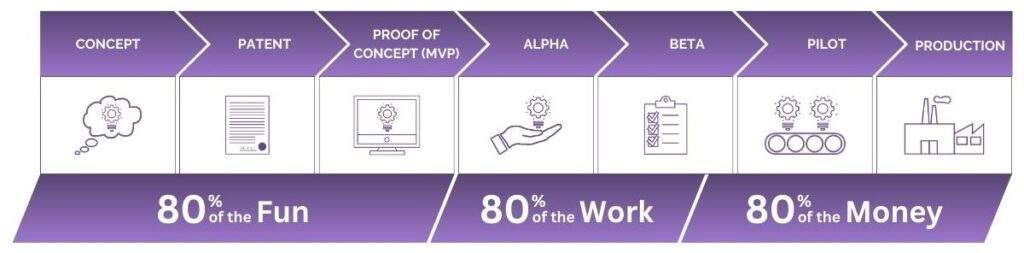
It is well-assumed that developing a product involves a lot of work and costs a lot of money. There are also some enjoyable and rewarding aspects of bringing a new product to the market. While all three of these are present throughout the process, some are more prominent during some phases than others.
80% of the Fun
80% of the Work
80% of the Money
The first 1/3 of the project is where most of the fun takes place. Concept, ideation, patenting, and the MVP phases are undeniably exciting, especially for the first-time inventor. There’s a lot of discovery and set-backs feel like opportunities to find solutions. This is where creativity flows freely, and the potential of your product comes to life.
The middle 1/3 of the project is where the tedious and detailed work takes place. In Alpha and Beta phases is where the real engineering happens, iterating the design and testing to ensure it functions flawlessly. The set-backs become frustrating and the iterations can feel unending. This meticulous, detail-oriented work lays the foundation for a successful ramp into production.
The last 1/3 of the project costs more than the other phases combined. To bring the product to market requires inventory, capital equipment investment, tooling and regulatory testing. Pilot production and full-scale manufacturing require significant investment. Without the completion of work done in Alpha and Beta, these stages become exponentially more expensive.
Why Skipping Alpha and Beta is a Recipe for Disaster
Those unfamiliar with the effort involved in developing a hardware product, tend to want to leap from their MVP to initial production. The work remains, but where it is done and who has ownership of the final design become the variables. “Leaping” is not a shortcut, but a lengthy detour that will end up costing more and taking longer because the product is not ready for manufacturing. There is a general oversimplification of the work needed and a common belief is that the supplier can make the necessary ‘tweaks’ to ready the product for production.

Depending where the supplier is located, the response to an unfinished product can vary. As a rule, manufacturers prefer to make the product and not design it, even those with designers on-staff. Suppliers based in the USA, Canada, or western Europe will either no bid the manufacturing or provide a sizeable quote for engineering.
For suppliers based in Asia, and more typically China, they will take on the challenge based upon assumptions since despite our admonition to write down a detailed list of requirements, requirements to remain undocumented. The supplier may offer to complete the design for no or low cost, because they intend to recoup those costs during manufacturing.
- Multi-year manufacturing contract – these contracts are intended to lock the product owner into a long enough contract that they can recoup their engineering costs and make their target profit on the manufacturing. These contracts can be extremely difficult to terminate.
- Creating a competitive market – when the product is redesigned for manufacturing significant intellectual property is created in the design process. This may be even more significant than what is filed in the patent because it holds the details about how to fabricate and assemble the product. The supplier can take the design and create their own branded product that they release in production creating a competitor before you can get to market. While this isn’t very common, it does occur.
- Intellectual property loss – even if the supplier doesn’t maliciously use the design data against you, they can state they own the IP because you didn’t pay for it. By withholding design files, your product manufacturing is a hostage and you are unable to leave because without the detailed designs. If you go to another manufacturer, you will likely need to start back where you did when you first contacted your current manufacturer.
While these risks tend to be a worst-case scenario, they are far too common. If you are fortunate enough to find a supplier who can build your product, you’re setting your company and brand up for additional risks.
- High manufacturing costs – if a supplier attempts to fabricate your product, it will likely require a lot of extra labor and/or have low yield. Either of these will result in a higher unit cost, which may impact your market competitiveness.
- Quality issues – beyond low yield in production, statistically some defective or borderline products will be shipped to customers. These do not usually immediately fail when the customer receives them, but within the warranty period. Your brand’s reputation can be damaged if there are a lot of product replacements or recalls.
- Poor reliability – products that haven’t gone through rigorous testing during Alpha and Beta phases, may not function in the corner cases or at edges of the operating range. This can result in failing to meet customer expectations and it can be expensive to make changes after launch.
- Safety & regulatory concerns – untested products could pose safety risks to users. This is a worst-case scenario that can result in lawsuits, product recalls, and severely damage your brand’s reputation. Even in a best-case scenario, skipping regulatory testing (e.g. FDA, FCC, FAA) could result in fines and industry-mandated stop-ships that both impact the bottom line with risk to your brand’s reputation.
Skipping the Alpha and Beta phases might seem like a way to streamline the development process, but it will cost more and take longer to achieve the desired results.

Alpha & Beta: Preparing for Reality
The Alpha and Beta phases are all about iterating on your MVP until it meets the requirements. It’s in these phases that your product transforms from a promising concept into a manufacturable reality. Below is a breakdown of what happens in each phase.
Alpha Phase: First Draft of the Final Product
The Alpha phase is the iterative process of designing and executing the product against the requirements and for the production manufacturing processes. Up to this point, there has been design activity, but it has mostly been exploratory to determine what your product needs to do.
Once the design is completed, the parts are fabricated to be evaluated individually and then as a system. Here at Zebulon Solutions, our engineering team subjects your product to a battery of tests designed to confirm if the product meets the requirements. This is where the initial excitement of the MVP meets the nitty-gritty of real-world functionality.
ITERATE, ITERATE, ITERATE
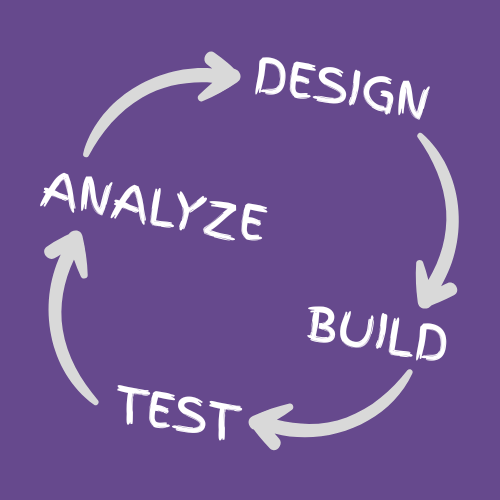
Within Alpha, there are almost always additional hidden iterations. Testing will inevitably reveal problems in the design. While it is good to plan for success, don’t be frustrated with failure that begins another round of design and testing. Each iteration should move the product closer to the requirements and ultimately what the market wants. Prematurely advancing the design to the next phase will increase your costs and extend your timeline.
The iterative process applies to test plans and requirements as well. It is better to make these changes early to avoid redoing engineering and design efforts later. A word of caution: trade-offs need to be carefully evaluated when changing requirements because designing a product the market won’t be interested in will lead to business failure.
BEYOND TESTING
The Alpha phase isn’t just about identifying problems; it’s also about exploring solutions. While many problems are solved by adapting the design, considering how it is manufactured or tested could identify solutions. At Zebulon Solutions, our team works collaboratively with our clients to brainstorm creative solutions and understand the full picture.
By the end of the Alpha phase, you’ll have a much clearer picture of your product’s strengths and weaknesses. With a well-defined and tested design, you’ll be better positioned to enter the Beta phase with confidence.

Beta Phase: Preparing for Production
The Beta phase is where your product graduates from the highly iterative process in Alpha. If your approach has been comprehensive in Alpha, Beta should be a ‘tweak’ on the Alpha design before you start spending “80% of the money” on tooling and other capital expenditures to prepare for production.
The test results captured during the Beta phase are pure gold. It allows you to refine your product and address any concerns before full-scale production. This might involve making tweaks to the user interface, optimizing performance, or even making minor design changes based on user feedback.
We strive to solve most hidden iterations within Alpha, but you can still iterate here too. It is much worse to release a product to the market with fatal flaws, so carefully evaluate the flaw against the cost of a Beta redesign and the implications on repeating tests.

COMMENCE 80% OF THE MONEY
When the engineers are confident that the design meets the requirements, custom tooling should be purchased and initial parts produced for evaluation against the design. Hopefully, only minor changes are needed as significant changes can be very costly.
While we’ve discussed testing within engineering up to this point, specific planning for how the product will be tested during production should be conducted. No one wants to consider defects being created in production, but it is a reality. It is better to find them in the factory than for your customer to receive a non-functioning or poorly functioning product. Frequently, production test systems can be a project of their own with requirements and iterations, so it is advisable to develop a test system in conjunction with the product.
VALIDATION TESTING
The test plan developed and executed by engineers in Alpha will now be scaled up to more statistical quantities, utilizing certified laboratories as required. Laboratories may have been necessary in Alpha due to specialized equipment or testing protocols. A formal verification that the product meets regulatory and safety requirements will be necessary in Beta. Tests performed by these laboratories can be many thousands of dollars, so you will want high confidence the product will pass before starting the tests.
THE OUTCOME
By the end of the Beta stage, you’ll have a product that has been refined and tested by engineers and friendly end real users. You’ll have a wealth of feedback to inform the final design, ensuring your product is ready to launch with confidence and achieve market success.

The Zebulon Solutions Advantage
At Zebulon Solutions, we understand the importance of hidden iterations. Our experienced team will guide you through the Alpha and Beta phases, ensuring your product is refined and manufacturable. We’re here to help you with the “work” phases so you can reap the rewards in the pilot and production phases.
Don’t let the excitement of the MVP and success of production blind you to the iterative process between the two. Contact us today, and let’s turn your brilliant concept into a market-dominating reality.